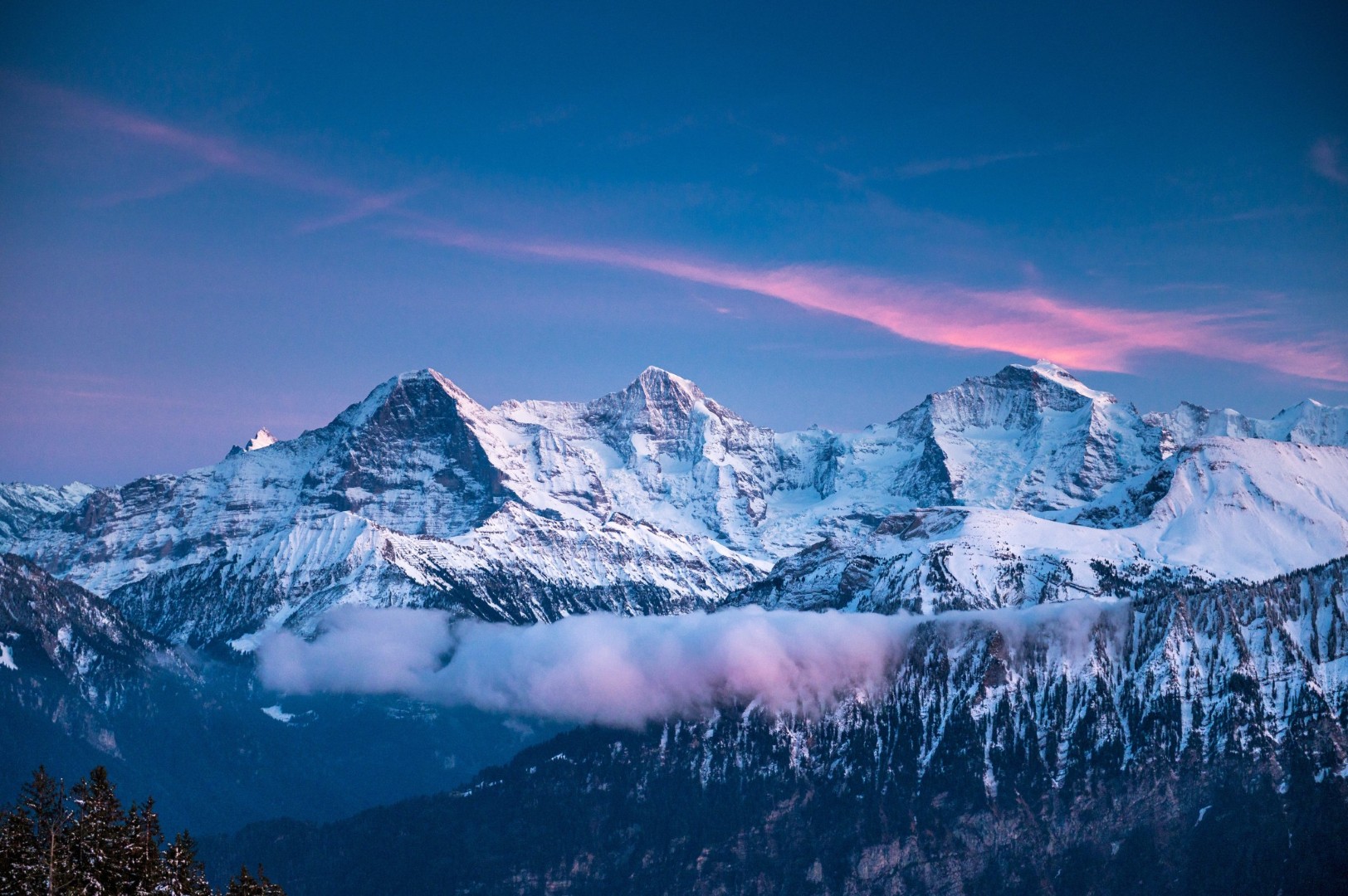
The eternal trinity of stone—the Ogre, the Monk, and the Maiden—standing guard over a landscape that has challenged climbers and inspired filmmakers for a century.
Station III · The Whispering Woods
The Giants Eiger · Mönch · Jungfrau
The Ogre, the Monk, and the Maiden — standing guard over a landscape that has challenged the living and inspired the immortal.
Act I
When Mountains Have Names
Stand here long enough and you begin to understand why people could not simply call them mountains. The three peaks that dominate this horizon have a quality that resists neutrality. They are too large, too present, too definitively themselves. When the first Alpine travellers looked up and reached for words, they reached for characters.
An ogre. A monk. A maiden. The popular legend writes itself from these names: the Eiger — the Ogre — looming to the north, perpetually scheming. The Jungfrau — the Maiden — standing untouched, pure, and far. And the Mönch — the Monk — positioned exactly between them, exactly as a guardian would stand, his bulk a permanent, silent refusal.
It is a story that the landscape seems to demand. From this very viewpoint in the Kleine Rügen, the geometry of the three summits makes the myth feel inevitable. The Monk really does stand between the other two. The Maiden really does recede. The Ogre really does loom.
A note on the names: The romantic guardian myth is a retelling the mountains have earned rather than one they were given. Historians suggest Jungfrau most likely derives from the meadow below, once owned by the Augustinian nuns of Interlaken Monastery. Mönch probably comes from Müncheberg — a pasture where horses grazed. Eiger from the old Germanic for a high, sharp peak. The names were humble before they became legend. The oldest written record of the Eiger dates to 1252 — long before anyone thought to climb it, or tell stories about it. But perhaps that is the deeper truth: some landscapes are so powerful they generate mythology almost by accident, from the smallest seeds of language.
There is, however, an older story — one that belongs to the people of this valley. On the Wengernalp, the meadow directly below the Jungfrau, a family of cruel giants once lived. They were feared across the region for their contempt toward the poor and the wandering. One day, an old man in worn-out clothes came begging for milk. The giants refused him and mocked him. What they did not know was that the old man was a mountain spirit, and far stronger than any of them. He cursed the giants for their cruelty. They began to grow, and grow, and grow — until they became what they are: solid rock and ice, locked in the sky forever. The father became the Eiger. The sons became the Monks. And the daughter, the youngest and the most beautiful, became the Maiden of the Alps.
They are still there. They will outlast everything else in this valley. They have already outlasted most of recorded human history. And from this clearing in the Whispering Woods, on a winter night with the Aurora Helvetica breathing above the trees, you can see all three of them, exactly as they have always been.
“The mountains were not climbed because they were beautiful.Alpine tradition
They were climbed because they were there — and because they dared men not to.”
Act II
Blood on the Stone
The legend was one kind of reckoning with these mountains. The climbers offered another. From the early nineteenth century, the question was no longer what the mountains meant — but whether a human being could actually stand on top of them.
Johann Rudolf Meyer & the Jungfrau
The Eiger Nordwand
The Nordwand became the mountain that cinema could not ignore. In 1974, Clint Eastwood arrived at the foot of the Eiger with a film crew, a spy thriller script, and a personal conviction that if you were going to make a film about climbing the Eiger, you had to actually climb the Eiger.
Act III
When the World Came to Watch
There is a structure perched on the saddle between the Mönch and Jungfrau at 3,571 metres — the second highest point in Switzerland accessible to the public — that looks as though it was designed by a Bond villain and built by a science fiction production designer. It is called the Sphinx Observatory, constructed in 1937 as a high-altitude research station. Its circular dome and sheer rock platform have made it one of the most photographed and most filmed buildings in Europe. From this station in the Whispering Woods, on a clear night, you can see its silhouette against the stars.
The wider mountain massif visible from this clearing has drawn filmmakers from across the world for more than half a century. Each came looking for something different — and each found it in the same three peaks.
The relationship between Bollywood and the Jungfrau region spans six decades and over two hundred films. It began when director Yash Chopra honeymooned in Switzerland in 1970 and fell, permanently, in love with this landscape. His 1989 film Chandni — featuring the Jungfraujoch — launched an era. His 1995 masterpiece Dilwale Dulhania Le Jayenge, directed by his son Aditya Chopra and starring Shah Rukh Khan and Kajol, became the longest-running film in Indian cinema history. It ran continuously at one Mumbai cinema for over a thousand weeks. Its Swiss sequences — filmed across the Jungfrau region and up to the Jungfraujoch — transformed Switzerland into the dream destination for an entire generation of Indian travellers.
Yash Chopra’s contribution to this region was so profound that a lake near Interlaken was renamed Chopra Lake in his honour. A Jungfrau Railways train bears his name. He was made honorary Ambassador of Interlaken. The mountains above us were his obsession, and through his films, they became the obsession of hundreds of millions of people who had never visited the Alps. Kuch Kuch Hota Hai (1998) brought Shah Rukh Khan back. Many more followed. The tradition continues today.
Among the peaks visible from this station, one has a story that belongs to an entirely different kind of imagination. The Silberhorn — the silver horn — is a subsidiary summit of the Jungfrau, just visible to the south. In 1968, the author J.R.R. Tolkien identified it in a letter as “the Silvertine (Celebdil) of my dreams” — the mountain peak he had seen as a young man camping near Mürren in 1911, which became, in his imagination, the summit where Gandalf and the Balrog climbed the Endless Stair and fought their final battle above the clouds. The Eiger, Mönch and Jungfrau themselves are believed to have inspired the three peaks of the Misty Mountains — Caradhras, Celebdil, and Fanuidhol — beneath which the Dwarves of Moria built their kingdom. The mountains that became Alderaan also, quietly, became Middle Earth. Continue along the path to Station IV, where this story finds its full telling.
The Trail Continues
They were here before the first human word was spoken in this valley. They will be here long after the last film credit rolls. Tonight, standing in the light of the Aurora Helvetica, you are simply the latest in a very long line of people who looked up and could not look away.